


News

2026.08.18
Traditional command centers were built to bring video feeds into one room. They gave operators a central place to monitor cameras, but still relied on people to spot problems, verify alarms, and decide what to do next.
That approach becomes less effective as organizations add more cameras, connected devices, facilities, and business systems. Operators face too much information, false alarms create unnecessary work, and critical events can be missed.
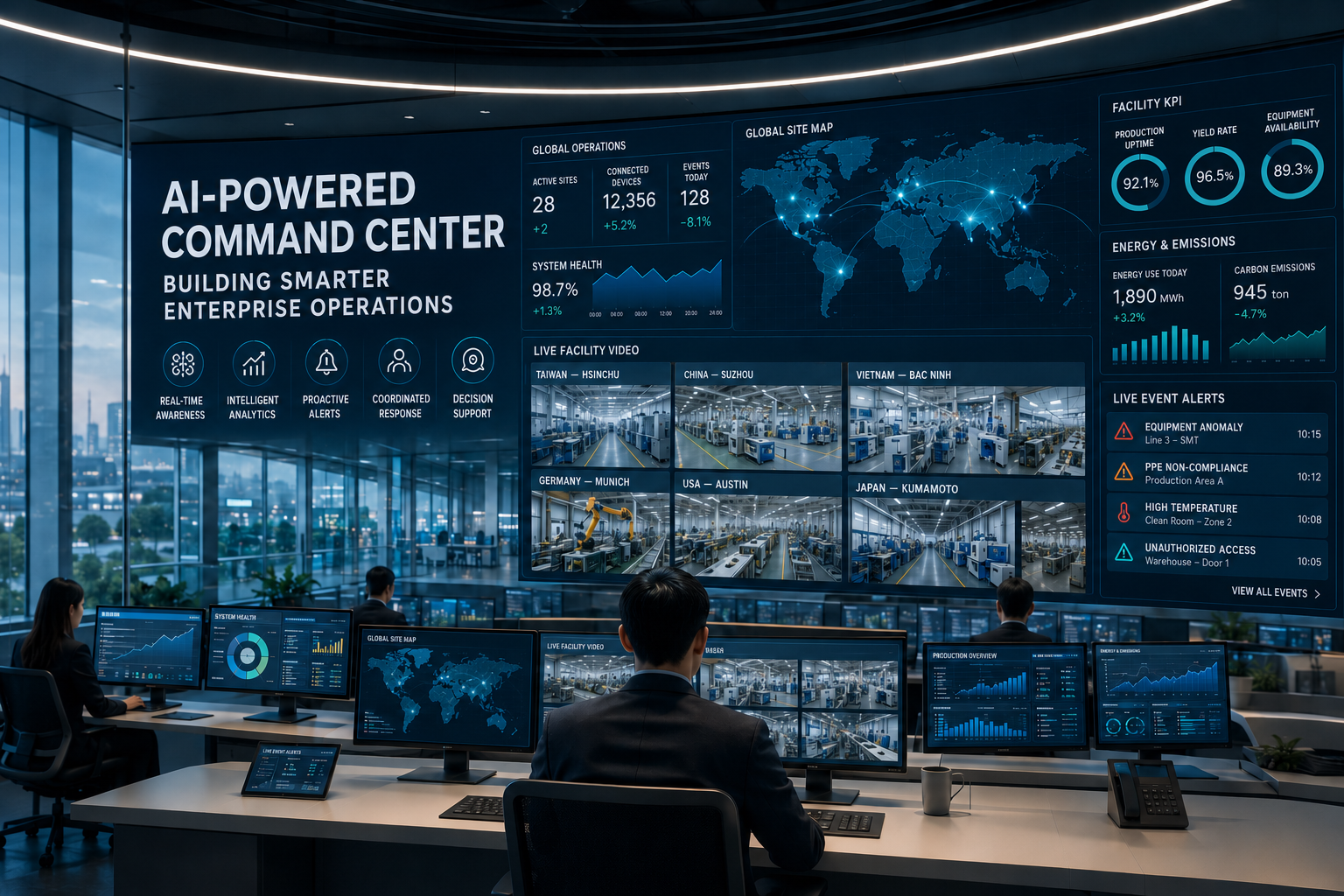
An AI-powered command center changes that model. It connects video, sensors, operational systems, and AI on one platform—helping teams detect important events, understand what is happening, and respond faster.
The goal is not simply to monitor more screens. It is to turn real-time operational data into action.
01|What Is an AI-Powered Command Center?
An AI-powered command center is a centralized operations platform that brings together:
- Live and recorded video
- AI-generated events and alerts
- Access control and IoT data
- Equipment and system status
- Maps and Digital Twins
- Operational dashboards and KPIs
- Enterprise systems and knowledge bases
Instead of asking operators to watch every camera, AI identifies events that require attention and provides the relevant context.
When an incident occurs, the command center can show the location, live video, event type, related equipment data, and recommended response. It can then notify the appropriate team based on predefined rules and responsibilities.
This helps organizations move from watching and reacting to detecting, understanding, and responding.
02|The Four Layers of an AI-Powered Command Center
An AI Intelligent Command Center adopts a comprehensive top-down architecture, creating a highly coordinated operational loop that connects on-site data collection and analysis with management-level decision-making.
|
|
|
|
03|Where Can AI-Powered Command Centers Be Used?
Because the architecture is modular, it can be adapted to different industries and operating environments.
Manufacturing
Connect production equipment, AI video analytics, MES, energy systems, and safety data to monitor production status, workplace hazards, and operations across multiple facilities.
Logistics and Warehousing
Combine video, access control, license plate recognition, AGVs, environmental sensors, and WMS data to improve vehicle, workforce, inventory, and facility management.
Smart Cities and Transportation
Bring together traffic monitoring, public safety alerts, road conditions, and incident data to give authorities a clearer view of citywide operations.
Corporate Campuses and Airports
Integrate access control, visitor management, parking, elevators, energy use, and environmental systems into one operational view.
Critical Infrastructure
Connect CCTV, SCADA, IoT sensors, and AI analytics across power plants, substations, reservoirs, and petrochemical facilities to improve early warning, equipment monitoring, and operational safety.
04|How to Build an AI-Powered Command Center
Building a command center does not require replacing every system at the same time. Most organizations can take a phased approach.
Step 1|Assess the Existing Environment
Identify current cameras, access control systems, IoT devices, sensors, and business platforms. Determine which equipment can remain in use and where integration gaps exist.
Step 2|Create a Unified Management Layer
Deploy Argo AI VMS to centralize video, devices, alarms, events, user roles, and system status.
Step 3|Build the Operational View
Add electronic maps, Digital Twins, live video, event panels, and KPI dashboards based on how operators and managers need to work.
Step 4|Add AI and Agent-Based Workflows
Introduce AI analytics, VLMs, LLMs, RAG, and AI Agents based on specific use cases. Start with high-value workflows such as incident verification, video search, SOP recommendations, or automated reporting.
This phased approach allows organizations to show value early while building toward a more complete intelligent operations environment.
05|Five Business Benefits
1. Reduce Manual Work
AI helps operators focus on events that matter instead of continuously watching every video feed.
2. Respond Faster
Teams receive the event location, live video, supporting data, and recommended procedure in one place.
3. Manage Multiple Sites Centrally
Organizations can monitor distributed facilities, equipment, and events through a unified interface.
4. Make Better-Informed Decisions
Video and operational data are presented in context, helping managers understand what is happening and decide what to do next.
5. Build a Scalable Operations Platform
A modular architecture allows organizations to add new sites, devices, AI models, and business systems as their needs evolve.
From Video Monitoring to Intelligent Operations
An AI-powered command center is not defined by the number of screens on the wall. Its value comes from connecting video, devices, IoT data, AI, and enterprise systems in a way that helps people act.
With Argo AI VMS as the central management platform, Spark connects existing cameras and field equipment with Digital Twins, business systems, and AI Agents.
Organizations can start with their existing infrastructure and expand in phases—from centralized monitoring and event management to AI-assisted analysis and decision support.
Further Reading: Traditional vs. AI-Powered Command Centers: How Should Enterprises Upgrade?
Traditional command centers were built to bring video feeds into one room. They gave operators a central place to monitor cameras, but still relied on people to spot problems, verify alarms, and decide what to do next.
That approach becomes less effective as organizations add more cameras, connected devices, facilities, and business systems. Operators face too much information, false alarms create unnecessary work, and critical events can be missed.
An AI-powered command center changes that model. It connects video, sensors, operational systems, and AI on one platform—helping teams detect important events, understand what is happening, and respond faster.
The goal is not simply to monitor more screens. It is to turn real-time operational data into action.
01|What Is an AI-Powered Command Center?
An AI-powered command center is a centralized operations platform that brings together:
- Live and recorded video
- AI-generated events and alerts
- Access control and IoT data
- Equipment and system status
- Maps and Digital Twins
- Operational dashboards and KPIs
- Enterprise systems and knowledge bases
Instead of asking operators to watch every camera, AI identifies events that require attention and provides the relevant context.
When an incident occurs, the command center can show the location, live video, event type, related equipment data, and recommended response. It can then notify the appropriate team based on predefined rules and responsibilities.
This helps organizations move from watching and reacting to detecting, understanding, and responding.
02|The Four Layers of an AI-Powered Command Center
An AI Intelligent Command Center adopts a comprehensive top-down architecture, creating a highly coordinated operational loop that connects on-site data collection and analysis with management-level decision-making.
|
|
|
|
03|Where Can AI-Powered Command Centers Be Used?
Because the architecture is modular, it can be adapted to different industries and operating environments.
Manufacturing
Connect production equipment, AI video analytics, MES, energy systems, and safety data to monitor production status, workplace hazards, and operations across multiple facilities.
Logistics and Warehousing
Combine video, access control, license plate recognition, AGVs, environmental sensors, and WMS data to improve vehicle, workforce, inventory, and facility management.
Smart Cities and Transportation
Bring together traffic monitoring, public safety alerts, road conditions, and incident data to give authorities a clearer view of citywide operations.
Corporate Campuses and Airports
Integrate access control, visitor management, parking, elevators, energy use, and environmental systems into one operational view.
Critical Infrastructure
Connect CCTV, SCADA, IoT sensors, and AI analytics across power plants, substations, reservoirs, and petrochemical facilities to improve early warning, equipment monitoring, and operational safety.
04|How to Build an AI-Powered Command Center
Building a command center does not require replacing every system at the same time. Most organizations can take a phased approach.
Step 1|Assess the Existing Environment
Identify current cameras, access control systems, IoT devices, sensors, and business platforms. Determine which equipment can remain in use and where integration gaps exist.
Step 2|Create a Unified Management Layer
Deploy Argo AI VMS to centralize video, devices, alarms, events, user roles, and system status.
Step 3|Build the Operational View
Add electronic maps, Digital Twins, live video, event panels, and KPI dashboards based on how operators and managers need to work.
Step 4|Add AI and Agent-Based Workflows
Introduce AI analytics, VLMs, LLMs, RAG, and AI Agents based on specific use cases. Start with high-value workflows such as incident verification, video search, SOP recommendations, or automated reporting.
This phased approach allows organizations to show value early while building toward a more complete intelligent operations environment.
05|Five Business Benefits
1. Reduce Manual Work
AI helps operators focus on events that matter instead of continuously watching every video feed.
2. Respond Faster
Teams receive the event location, live video, supporting data, and recommended procedure in one place.
3. Manage Multiple Sites Centrally
Organizations can monitor distributed facilities, equipment, and events through a unified interface.
4. Make Better-Informed Decisions
Video and operational data are presented in context, helping managers understand what is happening and decide what to do next.
5. Build a Scalable Operations Platform
A modular architecture allows organizations to add new sites, devices, AI models, and business systems as their needs evolve.
From Video Monitoring to Intelligent Operations
An AI-powered command center is not defined by the number of screens on the wall. Its value comes from connecting video, devices, IoT data, AI, and enterprise systems in a way that helps people act.
With Argo AI VMS as the central management platform, Spark connects existing cameras and field equipment with Digital Twins, business systems, and AI Agents.
Organizations can start with their existing infrastructure and expand in phases—from centralized monitoring and event management to AI-assisted analysis and decision support.
Further Reading: Traditional vs. AI-Powered Command Centers: How Should Enterprises Upgrade?